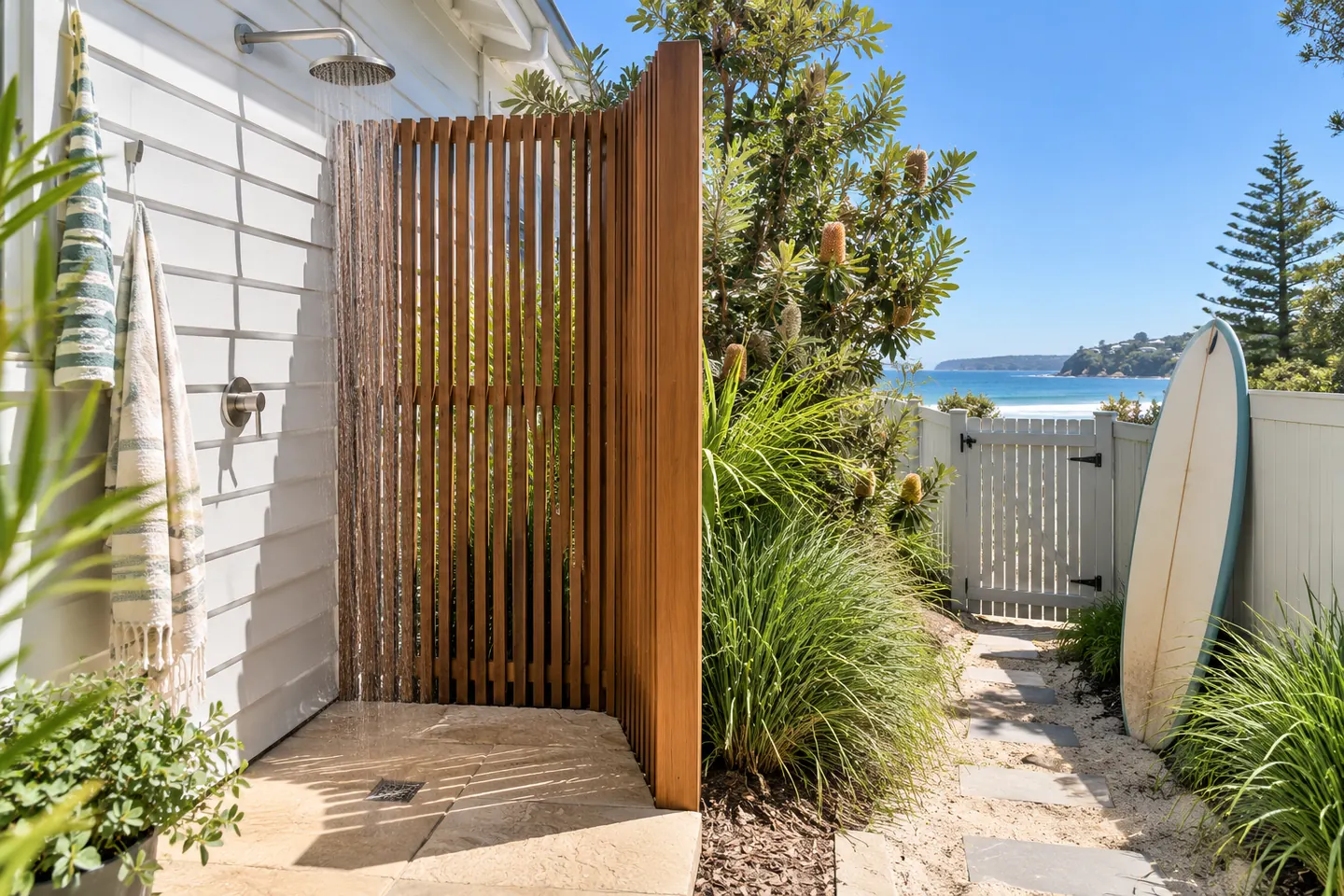
The sandy end of the house
In a beach household, the laundry often doubles as a mudroom. Wetsuits hang over the tub, boogie boards lean in the corner, and a trail of sand leads from the back door to the main bathroom.
A renovation can give that traffic a proper route: rinse outside, hang wet gear in the laundry, and arrive at the main bathroom without a beach's worth of sand.
Outdoor showers
Where they work
- Beside the back gate or side path, on the way in from the beach
- Next to the pool, for a rinse before or after swimming
- Near the garage where surfboards and bikes are stored
- Against a wall with existing plumbing, which keeps costs down
What to decide
Cold only or hot and cold? A cold rinse is simple and cheap. A hot and cold mixer is more comfortable in winter and needs a hot water supply routed outside.
Wall-mounted or freestanding? A wall-mounted shower uses the house for support and plumbing. A freestanding column needs a footing and underground pipework.
Screening. A timber or composite batten screen gives privacy without closing the space in. Hardwood, well spaced to dry, suits the look of a beach house. Use stainless fixings.
Base. Options include a textured stone or porcelain pad, a timber deck with a drained tray beneath, or a gravel soak area where suitable.
Drainage and compliance
Where outdoor shower water goes depends on the site and use. If soap and shampoo will be used, the shower may need to drain to the sewer. Water should also be kept away from footings and neighbouring properties. A licensed plumber advises on the compliant arrangement, and all plumbing work in NSW must be carried out by a licensed plumber.
Fittings that survive outside
An outdoor shower on the coast is the harshest environment on the property. Choose:
- 316-grade stainless steel shower heads, arms and columns, or brass with a proven outdoor finish
- Stainless or hot-dip galvanised fixings for screens
- An isolation valve inside, so the outdoor supply can be turned off if needed
Rinse the fittings with fresh water regularly. Even marine-grade stainless will tea-stain if salt is left to sit on it.
Laundries
What a beach-house laundry needs
- A deep, heavy-duty tub big enough to wash a wetsuit
- A floor waste, so a dripping wetsuit or a hose-down is not a flood
- Hanging space for wet gear, with hooks over the tub or a drying rail
- Waterproofed floor and wall junctions
- Slip-resistant tiles that do not show every grain of sand
- Ventilation — an external window or a ducted exhaust
- Durable benches over the machines; laminate, compact laminate or porcelain
Engineered stone has been banned in Australia since 1 July 2024, so it is not an option for new laundry benches.
Laundries in units
Many Cronulla units have a laundry in a cupboard, a shared building laundry, or a combined bathroom-laundry. A European-style laundry behind doors needs waterproofing, a floor waste where required and adequate ventilation, and as with a bathroom, strata approval is generally required where waterproofing or plumbing is changing. See apartment and small bathrooms.
Laundries in older houses
In post-war houses in Woolooware and Kurnell, the laundry is often at the back, sometimes in a fibro-lined enclosed verandah or attached to the garage. Suspect sheeting is tested for asbestos before removal. Old concrete tubs and galvanised pipes are replaced while access is open.
A second toilet in the laundry
If the house has one bathroom, fitting a toilet into the laundry takes pressure off the main bathroom during busy summer mornings and when the pool is in use. The laundry's existing drainage often makes this more affordable than expected.
Pool fences, gates and wet paths
Where an outdoor shower sits near a pool, check that its position, screen and any tapware do not create a climbable object near the pool fence or interfere with the self-closing gate. Pool barrier rules in NSW are strict, and a new screen or shower column placed in the wrong spot can put an otherwise compliant fence at risk.
The path from the shower to the back door also matters. Choose a paving or tile with good wet grip, give it a fall away from the house, and consider a boot scraper or a slatted mat at the door so the last of the sand stays outside.
Doing it all together
Renovating the laundry, an outdoor shower and the main bathroom in one program shares the plumber, electrician, waterproofer and tiler. It also means the sand strategy is designed as a whole, rather than room by room.
The builder
Renovation work is carried out in partnership with Coastal Renovation Group, a licensed NSW builder, with plumbing carried out by licensed plumbers. Licence and insurance details are provided on request. See renovation costs for 2026 bands.
Call 02 5850 4715 or send the details through.
Also by the beach
Questions people ask before they commit
How much does an outdoor shower cost in Cronulla?
As a 2026 guide, a simple cold-water outdoor shower on an existing wall runs about $3,500 to $6,000. A hot and cold shower with a screen, a tiled or stone base and new drainage typically runs $6,000 to $10,000 or more, depending on how far the plumbing has to travel.
Where can an outdoor shower drain?
That is a plumbing compliance question and depends on the site and how the shower will be used, particularly whether soap or shampoo will be used. A licensed plumber will advise whether it needs to connect to the sewer and how to keep water away from the house footings.
What does a laundry renovation cost?
As a 2026 guide, most laundry renovations run $9,000 to $20,000. Adding a separate rinse tub, a second toilet, a floor waste or relocating the laundry pushes toward the upper end.