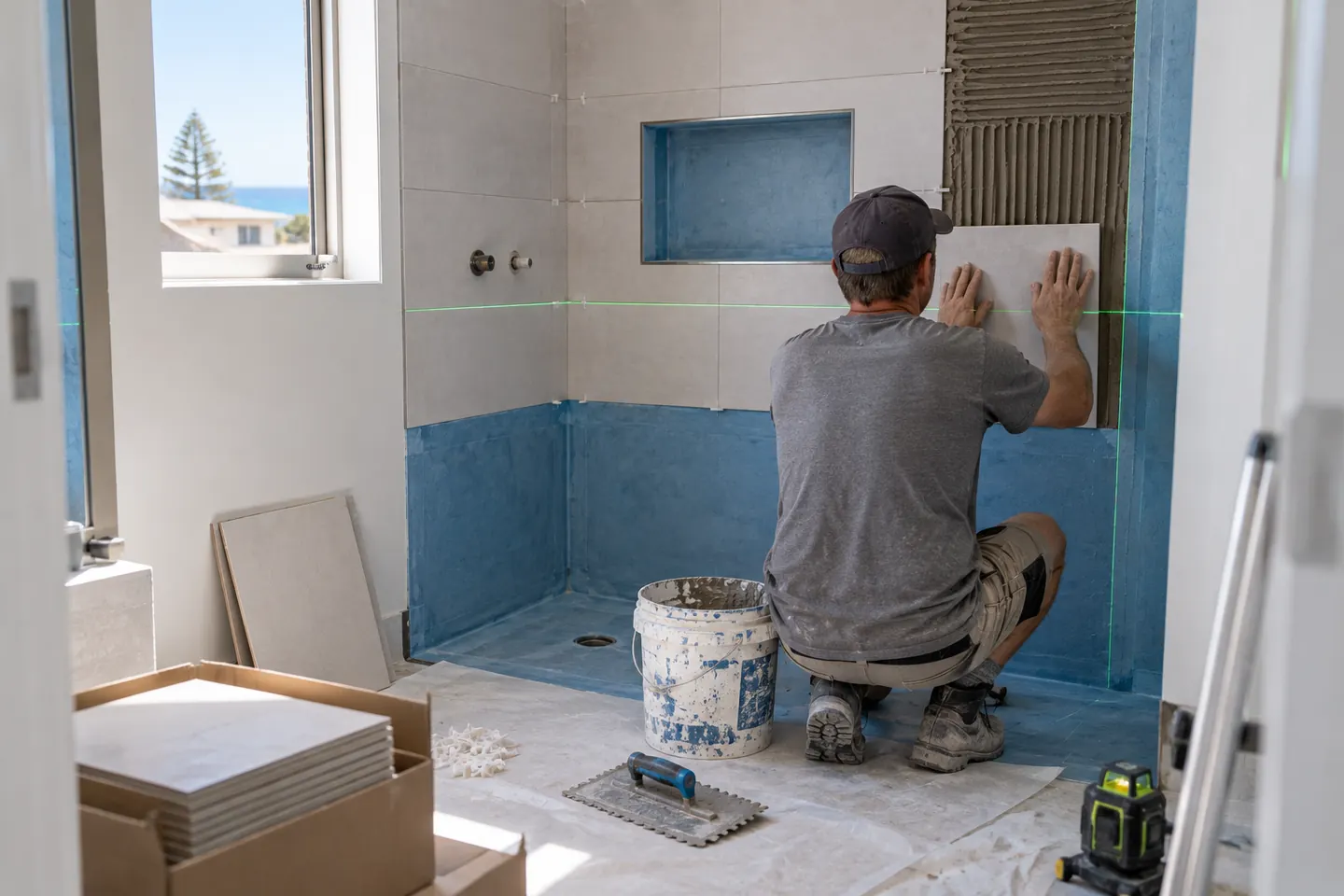
What beach-house tiles have to handle
Wet, sandy feet. A floor needs enough texture to stay safe when wet, without being so rough it is hard to clean. Sand scratches polished surfaces and shows on dark ones.
Salt residue. Salt-laden moisture dries on glossy tiles as a film. Matt and satin finishes show it less.
Humidity. Summer humidity and heavy use keep grout damp. Mould finds the weakest grout line.
Bright light. Coastal light is strong and reflective. Very white, glossy tiles can feel harsh; soft whites, sandy neutrals and pale stone looks sit more comfortably.
Choosing floor tiles
Slip resistance
Choose a tile with a tested slip rating appropriate for wet, barefoot areas, especially in the shower and at the bathroom door where wet feet arrive from the beach or pool. Your tile supplier can show the rating. Matt and textured finishes perform better than polished ones.
Colour and pattern
- Speckled terrazzo-look porcelain hides sand and water marks and suits the coastal look
- Warm stone looks in travertine or limestone tones pair well with timber vanities
- Soft grey and sand tones are more forgiving than stark white or charcoal
- Pattern tiles can add character to a small ensuite or powder room without dominating
Format
Larger floor tiles mean fewer grout lines, which is easier to keep clean. In a shower, a large tile works best with a linear drain along one wall so the floor only falls in one direction. With a centre waste, a smaller tile allows the fall to change direction without lipping.
Choosing wall tiles
Full height. Tiling to the ceiling, at least in the shower, avoids painted surfaces that blister in salty, humid air.
Easy clean. Satin or gloss wall tiles wipe down easily; the salt film that shows on floors matters less on walls.
Coastal palettes. Soft whites, pale blues and greens, handmade-look subway tiles, vertical finger tiles and textured feature walls all suit beach homes. Vertical layouts can make low ceilings in older units feel taller.
Grout and sealant
- Epoxy or high-performance grout on shower floors
- Narrow joints with rectified tiles where the substrate allows
- Mid-tone colours — light grey, sand, stone — that hide staining
- Flexible sealant at internal corners and wall-floor junctions, where movement happens
Good ventilation keeps grout cleaner than any product. See bathroom renovations for exhaust fan advice.
Set-out
A tiler's set-out decides where the cut tiles land. Good set-out centres tiles on the vanity or window, keeps full tiles at eye level, aligns grout lines with the niche and shower glass, and hides cuts in the least visible corners.
In older walk-ups and post-war houses, walls are rarely straight and floors rarely level. Preparation before tiling — flattening walls, correcting the screed — is what makes large, light-coloured tiles look right.
Tiling in units
In apartments, tile choice and tiling also affect the neighbours.
- Acoustic underlays may be required by some building by-laws for hard floors, though requirements vary and are more common for living areas than bathrooms. Check your building's rules.
- Floor height at the door must stay compatible with the corridor or hallway threshold.
- Removing old tiles is noisy and restricted to set hours.
See apartment and small bathrooms.
Outdoor and pool-side areas
Tiles at outdoor showers, pool bathrooms and laundry entries need to be rated for external or wet use, slip-resistant when wet, and laid with falls away from the house. Natural stone and textured porcelain pavers are common choices. See laundries and outdoor showers.
Niches
A recessed niche keeps shampoo and sunscreen off the floor. It should be waterproofed as part of the shower, sized to the tile so there are no thin slivers, and placed out of the direct spray. Stud walls make niches straightforward; masonry walls in older units need cutting and take longer.
What affects the price of tiling
- Area tiled and to what height
- Tile format: large-format tiles need more preparation and handling
- Pattern: herringbone, chevron and mosaics add cutting time
- Mitred corners instead of trims
- Niches and feature details
- Floor preparation in older, uneven rooms
- Access: carrying tiles up walk-up stairs
A simple layout with one well-chosen feature usually delivers more than an expensive tile laid in a complicated pattern.
The builder
Renovation work is carried out in partnership with Coastal Renovation Group, a licensed NSW builder. Licence and insurance details are provided on request. See renovation costs for how tile choices move the budget.
Call 02 5850 4715 or send the bathroom details through.
Also by the beach
Questions people ask before they commit
What floor tiles are best for a beach house bathroom?
A matt or lightly textured porcelain with a slip rating suitable for wet barefoot areas. Mid-tone, speckled or stone-look finishes hide sand and water marks better than plain white or dark gloss.
Are large tiles slippery in a shower?
They can be if the surface is smooth, and large tiles are harder to fall correctly to a centre waste. A textured large-format tile with a linear drain, or a smaller tile on the shower floor, gives better grip and drainage.
What grout lasts best in a humid coastal bathroom?
Epoxy and high-performance grouts resist staining and moisture better than standard cement grout, especially on shower floors. Mid-tone grout colours hide discolouration, and flexible sealant belongs at corners and junctions.